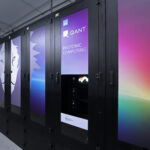
At LRZ in Garching, a photonic computer for AI use cases was put into operation in an HPC environment for the first time worldwide. The Native Processing Server (NPS) from German start-up Q.ANT uses light instead of electrons for computing and therefore does not require energy-intensive cooling. Through parallel processing at different wavelengths, the technology promises high computing power combined with high energy-efficiency…
LRZ: Blue Lion based on Vera Rubin chip architecture
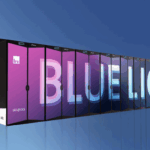
LRZ is set to deploy the Blue Lion supercomputer, powered by NVIDIA’s upcoming Vera Rubin architecture, as NVIDIA announced during ISC in June 2025. This system combines the Rubin GPU and Vera CPU, forming a superchip designed for real-time, large-scale scientific computing. Blue Lion aims to deliver approximately 30 times the performance of its predecessor, SuperMUC-NG, facilitating advanced research in areas like climate modeling, physics, and AI…
EU Commissioner Henna Virkkunen visits AI Factory HammerHAI
On July 7, 2025, Henna Virkkunen, Executive Vice-President of the European Commission for Technological Sovereignty, Security and Democracy, visited the High-Performance Computing Center Stuttgart (HLRS) as part of her tour of European “AI factories” established by the EuroHPC Joint Undertaking. The visit spotlighted HammerHAI, Germany’s first AI factory—launched in December 2024 and coordinated by HLRS along with partners such as the Leibniz Supercomputing Centre…
Replacing AI training with Math Methods
Artificial neural networks are becoming increasingly large and complex – and therefore require more and more energy for training with data. A research team led by Felix Dietrich, Professor of Physics-Enhanced Machine Learning at the Technical University of Munich (TUM), is working on replacing training steps with mathematical methods. This reduces power consumption and helps to better understand how artificial intelligence (AI) works…